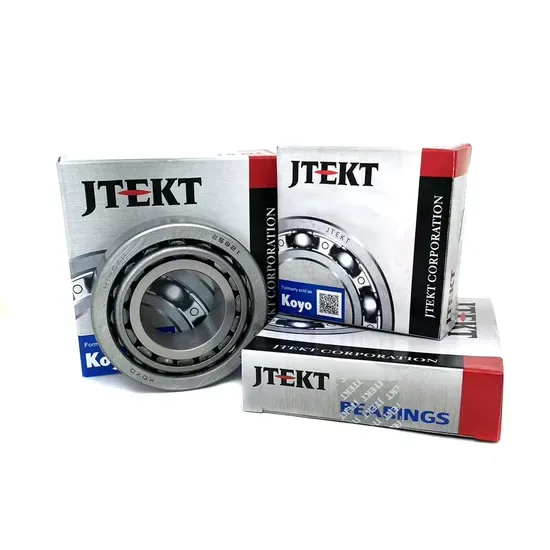
Never use an open flame to heat a bearing.
The correct method for installing Koyo bearings is controlled induction heating, which ensures uniform thermal expansion without altering the steel’s metallurgical structure. This process requires precise temperature monitoring to stay below the annealing threshold, typically around 120°C, and relies on genuine components with verifiable traceability to prevent premature failure caused by refurbished or counterfeit parts.
I still recall the silence in that Chicago heavy machinery workshop. It wasn’t the quiet of precision engineering; it was the hush of a costly mistake. A maintenance team had just installed what they believed were high-quality Koyo spherical roller bearings on a critical crusher drive. Within weeks, the unit seized. When we inspected the failed inner ring, the evidence was undeniable: localized discoloration and a softened surface layer. They had used a propane torch to expand the bearing for mounting, creating intense hot spots that destroyed the heat-treated matrix. The structural integrity was compromised long before the machine ever turned a full revolution. This scenario is not unique. Across industrial sites from the Middle East to Southeast Asia, improper heating techniques remain a leading cause of avoidable downtime. Understanding the physics behind Heating Koyo bearings for mounting is not just a technical detail; it is a fundamental requirement for operational reliability.
Why is controlled heating essential for Koyo bearings?
Controlled heating prevents structural annealing and maintains the original internal clearance specified by the manufacturer.
Bearings are precision-engineered components where every micron matters. The steel used in high-performance bearings like those from Koyo undergoes rigorous heat treatment to achieve specific hardness and toughness levels. When you apply heat, you are manipulating the physical dimensions of the metal through thermal expansion. However, if the heat source is uncontrolled, you risk exceeding the tempering temperature of the steel. Once this threshold is crossed, the steel softens—a process known as annealing. An annealed bearing raceway cannot withstand the contact stresses of rolling elements, leading to rapid deformation and failure.
Furthermore, the internal clearance of a bearing is carefully calculated to accommodate thermal expansion during operation and ensure proper lubrication film formation. Improper heating can distort the ring geometry, effectively destroying this clearance. Even if the bearing appears to fit, the altered geometry leads to increased vibration, noise, and heat generation during runtime. The goal of Heating Koyo bearings for mounting is to achieve a temporary, uniform expansion that allows for easy sliding onto the shaft without any mechanical force, while preserving the material properties and geometric precision intact.
What are the fatal flaws of open-flame heating?
Open flames create localized hot spots that cause uneven expansion and destroy the heat-treated steel matrix.
It is a common misconception that any heat source will do, provided it gets the job done. In reality, using a torch or open flame is one of the most damaging practices in bearing installation. The flame produces temperatures far exceeding the safe limit for bearing steel, often reaching several hundred degrees Celsius in seconds. More critically, the heat distribution is highly uneven. The side facing the flame expands rapidly, while the opposite side remains relatively cool. This differential expansion induces severe thermal stress within the ring, potentially causing micro-cracks or permanent distortion.
Consider a case from a refurbishment facility in Latin America. A batch of bearings was heated using direct flame to speed up the assembly line. The result was a significant increase in rejection rates during quality inspection. The inner rings had lost their roundness, and the hardness tests revealed soft spots where the flame had directly impinged. These defects are not visible to the naked eye immediately after installation but manifest as premature fatigue spalling once the equipment is under load. The belief that faster heating is better is dangerously flawed; rapid thermal shock degrades the steel matrix rather than preparing it for service. When discussing Heating Koyo bearings for mounting, it is crucial to emphasize that uniformity is more important than speed.
How to select and use the right induction heater?
Match the heater power to the bearing mass and strictly monitor temperature curves to ensure safety.
Selecting the appropriate equipment is the next critical step. Induction heaters are the industry standard because they generate heat directly within the conductive metal of the bearing, ensuring rapid and uniform warming. However, not all induction heaters are created equal. The power rating must be suitable for the size and mass of the bearing. An underpowered unit will take too long, risking heat loss to the environment, while an overpowered unit might heat too aggressively if not properly controlled.
Key features to look for include automatic demagnetization cycles and precise temperature control sensors. The heater should have a probe or infrared sensor that monitors the bearing temperature in real-time, shutting off the power once the target temperature is reached. This eliminates human error and guesswork. For distributors and MRO operators, investing in a quality proper induction heater for Koyo bearings is a strategic decision that reduces warranty claims and improves customer satisfaction. It is also vital to ensure that the bearings being heated are genuine. Counterfeit or refurbished bearings may have unknown material compositions or prior damage that makes them unsuitable for even controlled heating. Sourcing from a supplier with complete traceability documentation ensures that the components meet the original manufacturer’s specifications, providing a reliable baseline for the installation process.
What are the step-by-step safe mounting procedures?
Clean environment, precise temperature targeting, and proper seating are the pillars of a successful installation.
Even with the best equipment, the procedure must be followed meticulously. Begin by ensuring the work area is clean and free of contaminants. Dirt or debris can become embedded in the bearing surfaces during installation, causing immediate damage. Verify that the shaft is clean, dry, and free of burrs. Measure the shaft diameter to confirm it is within tolerance.
Set the induction heater to the recommended temperature, typically no higher than 120°C for standard bearings. Place the bearing on the heater’s yoke or support, ensuring it is centered for uniform heating. Activate the heater and monitor the temperature rise. Once the target temperature is reached, quickly remove the bearing using heat-resistant gloves. Slide it onto the shaft smoothly. It should glide into position with minimal resistance. Do not force it. If it sticks, do not hammer it; reheat it slightly. Allow the bearing to cool naturally to room temperature. As it cools, it will contract and grip the shaft tightly. Avoid using cooling sprays or water to accelerate this process, as rapid cooling can also induce stress. Throughout this process, the focus on Heating Koyo bearings for mounting ensures that the final assembly is secure, aligned, and ready for service.
Conclusion
Proper installation dictates bearing life.
The difference between a bearing that lasts for years and one that fails in weeks often lies in the mounting process. By rejecting outdated methods like open-flame heating and adopting controlled induction techniques, you protect the integrity of the component. Ensuring the authenticity of the parts through verified supply channels further mitigates risk. Mastering the art of Heating Koyo bearings for mounting is a small investment in time and training that yields substantial returns in equipment reliability and operational efficiency.